1910-1920
1910-1920
The newly formed Ayr United Football Club had the option of two grounds to use as a base. Somerset Park was chosen. The playing attire was amalgamated too. Ayr United's strip comprised the crimson and gold hooped shirts of Ayr FC and the blue shorts of Parkhouse. The first match was a midweek friendly at home to Hurlford. Then, on the Saturday, Port Glasgow Athletic visited for a Second Division fixture in which Archie Campbell and Charlie Howe scored in a 2-0 win.
On 26th November, 1910, a 4-3 defeat at home to Abercorn caused people to question the wisdom of the amalgamation. The Ayr Observer commented: "One left the field on Saturday, mingling with the downhearted supporters of the crimson and gold and listened to the many threats never to come back again." It was a fickle attitude. Ayr United did not lose another home league match until 17th August, 1912, when the damage was inflicted by the Paisley-based Abercorn. The inaugural 1910/11 season ended in a runners-up spot but the club failed to get enough votes on applying for inclusion to the First Division. The Ayrshire Post was prompted to state: "There is no doubt that the method of automatic promotion in force in the English League competition is the right and proper one."
Under Bert Tickle's captaincy Ayr United won the first nine league fixtures of 1911/12. This remains a club record league start. It was decided to run a team at Junior level, effectively a reserve side. Home matches were to be played at Beresford Park. Juniors played their first match on 9th September, 1911. It was the occasion of a 1-0 defeat away to Craigmark Smithfield in the Ayr and District League. Playing at this level meant that Ayr United could field a team in the Scottish Junior Cup. On 16th December a league point was dropped for the first time in 1911 since 7th January. It happened in a 2-2 draw against Dundee Hibs at Tannadice Park. A week later a 4-2 home win over Leith Athletic left the club on top of the table with 21 points from a possible 22. Ultimately the Second Division title was won by beating Albion Rovers 4-0 at home on the same afternoon that near rivals Dumbarton lost 4-2 to Dundee Hibs at Tannadice Park.
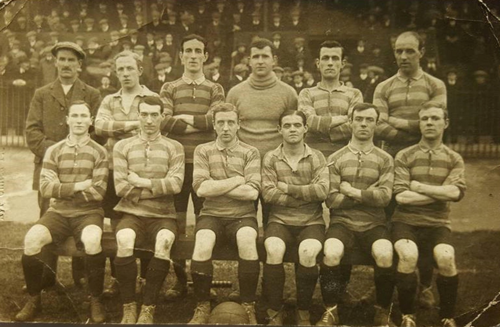
Promotion then depended on the outcome of the annual general meeting of the Scottish Football League which was scheduled for the Monday evening of 3rd June. There was a motion from the Celtic delegate to the effect that the highest club in the Second Division should automatically pass into the First Division. The necessary two-thirds majority agreed. Then the St. Mirren delegate complained that the motion would mean the relegation of his club and he told the meeting that they had already committed themselves to a First Division wage bill. Extraordinarily it was decided to do a u-turn on the motion and that the matter of automatic promotion would be held over until the next annual general meeting. The Ayrshire Post opined "It was understood, however, that the meeting virtually decided for automatic promotion twelve months hence." In truth Scottish football was a decade away from automatically promoting the Second Division's top club.
At the end of 1912/13 the Second Division title was retained. Runners-up in 1910/11 and champions in seasons 1911/12 and 1913 - promotion again depended on the yearly farce known as the annual general meeting of the Scottish Football League. It took place on the Monday evening of 2nd June, 1913. Club chairman Tom Steen worked hard in support of Ayr United's application. This was necessary. The matter of league points was a lesser consideration than chamber eloquence. "Nothing has been talked about by football followers in Ayr since the close of last season but the United's prospects of promotion to the First League" - the Daily Record was commendably well informed. It was known that the result would be sent by telegram to the Ayrshire and Galloway Hotel, outside which a large crowd assembled in bad weather. There was great jubilation when the news came through that Ayr United had been promoted. It had been proven that the Scottish Football League could display a reluctance to relegate clubs from the First Division. Had this body now relented? No they had not. There was no relegation in 1913. A decision had merely been made to extend the top tier by two clubs. The other promoted club was Dumbarton who had finished sixth.
In preparation for First Division football the number of turnstiles at Somerset Park was increased from nine to fourteen. Sam Herbertson, fated to fall at Gallipoli, was a goalkeeper signed from Beith. Full-back John Bell was acquired from Cowdenbeath where he was on loan so Ayr United had to negotiate with his parent club Rangers. Billy Middleton, an outside-right, was signed from Brighton and Hove Albion and outside-left Alec Gray was acquired on loan from Celtic, although Ayr United would eventually pay a fee of £225 for him in 1920, the player having remained throughout.
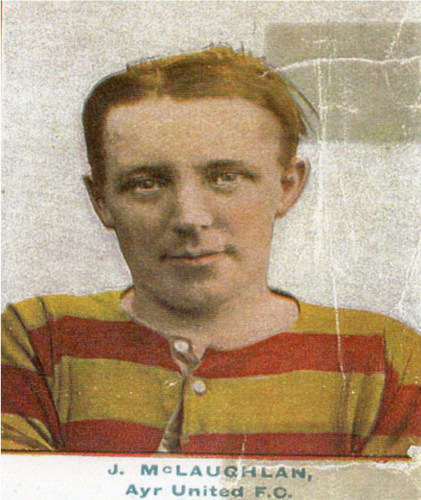
Team strengthening was necessary for the challenge ahead. Half-back Switcher McLaughlan was a veteran of the first Ayr United team. He was a highly popular half-back with a cannonball shot. Full-back Willie McStay, acquired on loan from Celtic in 1912, was the captain. Yet the future star of the team was Johnny Crosby, signed in October 1913 from Muirkirk Athletic. For season 1913/14 it was decided to disband Ayr United Juniors in favour of a reserve team.
The introduction to the top sphere was somewhat sobering with the first four fixtures ending in defeat. Then came a defeat away to Stevenson United in the Scottish Qualifying Cup. The first points on the board came with a 3-1 win away to Scottish Cup holders Falkirk which was followed by a 1-0 win away to Kilmarnock. A tenth-place finish in the twenty-club league was acceptable in view of the fraught start. Jimmy Richardson, a centre-forward, was signed from Sunderland in March 1914. He was to become one the greatest Ayr United strikers of all time.
A historic decision was made by the Ayr United board. The club colours of crimson and gold were discarded in favour of black and white hooped shirts and black shorts. However the declaration of war cast doubt on whether the league programme of 1914-15 would even begin. Mobilisation was immediate. Johnny Crosby, Neil McBain and John Bellringer were players who had already enlisted. The following were to make the supreme sacrifice in the Great War.
THE FALLEN OF AYR FC, PARKHOUSE AND AYR UNITED
Corporal John Bellringer - Ayr United. 'C'Company. 1st/5th Battalion Argyll and Sutherland Highlanders. Died at Gallipoli at the age of 23 on 12th July, 1915.
Private Samuel Herbertson - Ayr United. 1st/4th Battalion Royal Scots Fusiliers. Died at Gallipoli at the age of 26 on 12th July, 1915
Private Robert Capperauld - Ayr United. 5th Battalion Royal Scots Fusiliers. Died on 14th July, 1915, after suffering wounds at Gallipoli.
Private Thomas Clifford - Ayr FC. 6th/7th Battalion Royal Scots Fusiliers. Died at Somme at the age of 42 on 19th January, 1917.
Private Hugh Kerr - Ayr FC. 14th Battalion London Scottish. Died at the Western Front on 10th April, 1918.
2nd Lieutenant William Kerr - Parkhouse. Machine Gun Corps 4th Battalion Royal Scots Fusiliers. Died at the Western Front at the age of 37 on 2nd September, 1918.
Archie Campbell - Ayr United. 119th Brigade Royal Field Artillery. Died of war wounds at the age of 38 on 14th September, 1918.
War work and military call-ups rendered 1914 - 1918 a difficult time for all football clubs in Britain. It became open house in terms of fielding players. Guest players could make an appearance for clubs in the vicinity of where they were billeted. It did not require any paperwork. Nor did it matter which club held their registration. Ayr United's highest ever league finish occurred in 1915/16 - 4th in the First Division. Yet the fickleness of these times created a situation whereby the club finished at the foot of the table in 1917/18.
Peacetime brought a boom in gates and Ayr United's prosperity was further enhanced by some significant transfer activity in the immediate post war years.
1920-1930
1920-1930
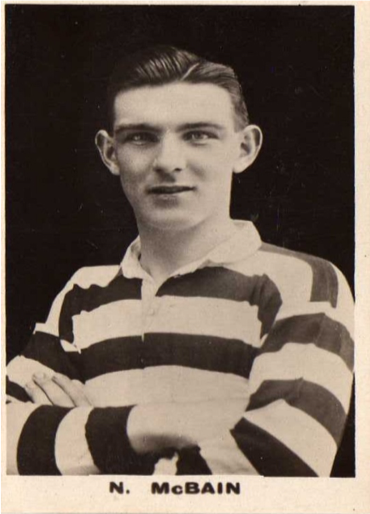
In January 1920 the Ayr United board announced that the club was going to buy Somerset Park and that it would be remodelled. A price of £2,500 was agreed with W.G. Walker and Sons, this is to be payable in five annual instalments of £500. Four months later Johnny Crosby was sold to Birmingham City for £2,800. The sale of Crosby therefore funded the purchase of the entire ground. Archibald Leitch was the foremost expert in the design of football grounds and this was the man Ayr United consulted. Leitch foresaw a full length stand and three sides of open terracing. He also foresaw the pitch being realigned to run parallel with Tryfield rather than at an angle as it had been since 1897. The cost of the envisaged stand was estimated at £8,000. It would have had a capacity of 2,592. Although the purchase of the ground was immediate, four years were to pass before the redevelopment work got underway, a major modification being a less expensive stand with 1,345 seats. Just as Somerset Park's purchase had been funded by the sale of a player so too was the cost of the new stand. Neil McBain was sold to Manchester United for £4,600 in November 1921. It was, at the time, a record fee for Manchester United (since eclipsed!). Although the purchase of the ground took place in 1920 four years were to pass before the bulk of the redevelopment work got started.
1920 also earmarked a transition with regard to personnel. Switcher McLaughlan, a veteran of the first Ayr United team, departed that summer. So too did the outstanding Billy Middleton and, as you have read, Johnny Crosby was already gone. Yet the team still had the appearance of being built on solid foundations. Full-backs Jock Smith (signed 1919) and Phil McCloy (signed 1918) would partner each other at international level while still at Ayr United. Half-back Jimmy Hogg (signed 1918) was another player destined to play for Scotland while still an Ayr United player. The last line of defence was the fearless George Nisbet, a goalkeeper who would instinctively dive head first into flailing boots. Centre-half Jimmy McLeod (signed 1921) was another who would be remembered as a club legend. Yet the total failed to reach the sum of its constituent parts. Individual brilliance brought nothing better than a final placing of fourteenth in the First Division in 1920/21 and the following season replicated this. Finishing tenth in 1922/23 was a false dawn when considered against a lapse to fourteenth in 1923/24. Fourteenth out of eighteen in three seasons out of four - if nothing else there was a consistency.
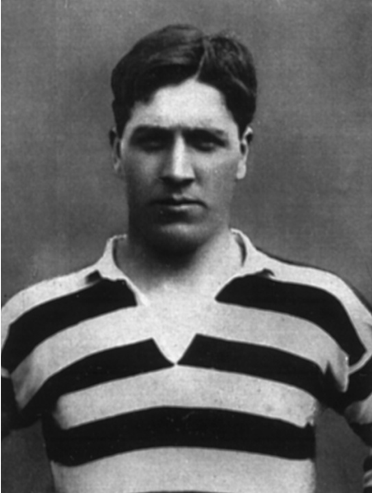
On 12th April, 1924, the first international match ever played at Wembley resulted England 1 Scotland 1 and the Scotland full-backs were the Ayr United full-backs. The Scotland team was: Harper (Hibs), Smith (Ayr United), McCloy (Ayr United), Clunas (Sunderland), Morris (Raith Rovers), McMullan (Partick Thistle), Archibald (Rangers), Cowan (Newcastle United), Harris (Newcastle United), Cunningham (Rangers) and Morton (Rangers). The Bulletin contained: "The Beith farmer kept plodding on and generally created a fine impression. He kicked powerfully and with accuracy and the longer the game lasted the better did he become. Alongside his less impetuous club mate, Phil McCloy, was tip-top. He played with just as much concern as if he was taking part in an ordinary humdrum match at Somerset Park."
If justice had been served the team would have reached the Scottish Cup semi-finals in 1924. At the end of the season Annual General Meeting chairman Lawrence Gemson said: "The manner of our defeat from the Scottish Cup will ever remain an unhappy memory." There was substance to his prediction. Even seventy two years later it was possible to find old supporters who were still embittered about Ayr United's Scottish Cup exit in that year. The subject of their unforgiven resentment was a quarter-final tie at Airdrie. With the score at 1-1 and the final whistle due, John Anderson drove the ball into the Airdrie net from a John McLean cross. The referee signalled a goal. With the Ayr players lined up for the re-centre, the home players surrounded the referee to protest about something which was unapparent. Referee Humphrey then disallowed the goal after consulting both the linesmen. There was two theories. 1. The Airdrie goalkeeper had earlier kicked from hand when a goal kick should have been given. This would have been an advantage to Airdrie and the referee beckoned for play to continue anyway. 2. John McLean was deemed to be in an offside position before delivering the cross. This would have been an equal travesty since there was no doubt that McLean was onside. The replay at Ayr was tied and the teams met at Ibrox on consecutive days before a Hughie Gallacher goal put Airdrie through. Airdrie lifted the Scottish Cup that year and Ayr United did not pass the quarter-final stage until 1973.
At the outset of season 1924/25 home games were played at Beresford Park pending completion of the renovations at Somerset Park. Amidst much pomp and ceremony the ground was reopened on 13th September, 1924, on the occasion of a league visit from Rangers. However the campaign, ended in a crushing disappointment. In consequence of Motherwell losing at Aberdeen on the final league Saturday, Ayr United required at least a draw at Ibrox to save the club from relegation. Rangers won 1-0. Near the end a Jimmy McLeod header missed the goal by a foot. A team rich in individual talent therefore went down to the Second Division.
Two failed attempts at promotion created a lot of public concern. This was the catalyst for the formation of an Ayr United Supporter's Club. Public ire was soothed in 1927. In May of that year Jimmy Smith was signed upon his release from Rangers. The season ahead was to see a scoring frenzy of such proportions that his name and that of Ayr United would find a place in the Guinness Book of Records. With the able assistance of inside-forwards Danny Tolland and Billy Brae he scored sixty-six league goals as the club romped to the Second Division title. As a reward there was an end of season tour to Norway and Sweden. The sea crossing from Newcastle to Oslo was rough in the extreme but the players recovered to acquit themselves well, even beating the Swedish International team 3-1 in Stockholm.
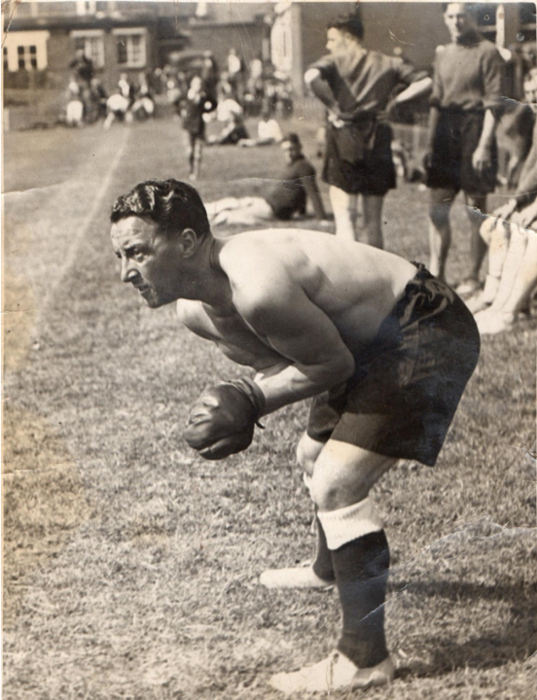
The return to the top sphere was daunting but at least the threat of relegation was staved off. Sixteenth in the twenty-club First Division amounted to consolidation. Ninth in 1929/30 amounted to commendable progress. By this time Andy McCall was excelling in the half-back line whilst winger Tommy Robertson lived up to his nickname of The Patna Flyer.
1930-1940
1930-1940
In the 1950s many fans reminisced on the 1930s as if that decade comprised a golden age. There were some fond memories but overall it was not a halcyon period. In the seven seasons for 1929/30 through until the conclusion of 1935/36, Ayr United conceded an average of 95.8 league goals per season. In 1930/31 the club had no league wins away from home and compounding the misery was a Scottish cup defeat at Bo'ness against the team sitting in bottom position in the Second Division. The adverse league form meant that a point was required from the last match in order to escape relegation. That match was at home to Kilmarnock! On a sunny evening Danny Tolland got the only goal with the consequence that Hibs got relegated with the already doomed East Fife.
A significant signing in the summer of 1931 was Fally Rodger, an outside-left who would go on to become a club legend after an apprenticeship at reserve level. Yet 1931/32 was like a continuation of the season before. It was a flirtation with relegation. A 6-0 defeat at Motherwell in November prompted an Ayrshire Post headline of DRASTIC CHANGES NEEDED. At the time it could never have been guessed that Motherwell would finish the season as champions of Scotland. A 17th place finish was merely an improvement of one place. As if by some form of arithmetical progression there was an improvement of one further place to 16th at the conclusion of 1932/33.
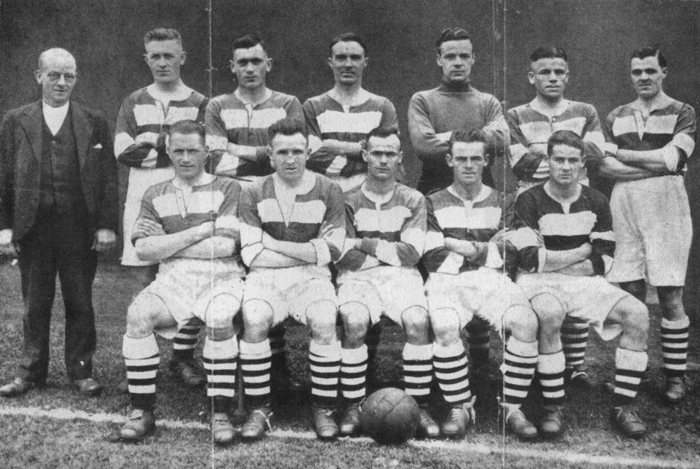
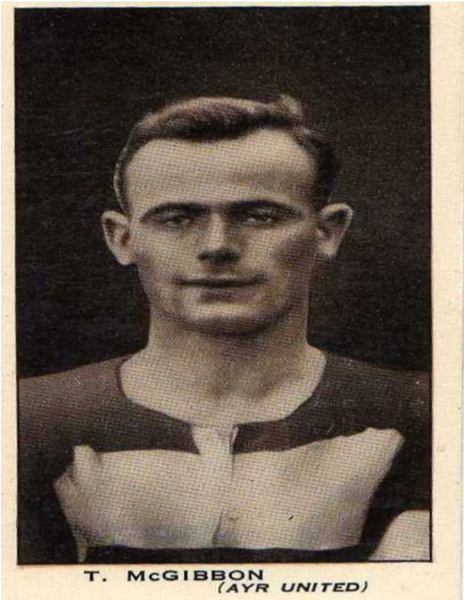
Very early in 1933/34, Alex Merrie, top scorer for the previous two seasons, found himself dropped. The reason why can be answered in two words. Terry McGibbons. McGibbons was a centre-forward signed from Irvine Meadow. He adapted to senior football straight away. By New Year in his first season he had amassed twenty-seven First Division goals. Third Lanark in particular felt the brunt. In the two league games against them in 1933/34 Terry scored ten. Six came in a 7-3 win at Cathkin Park and he got four in a 5-1 win in the return match at Ayr. Despite being a first season senior he was a travelling reserve for Scotland in the 1934 Wembley international. He finished the season with thirty-five league goals to his credit and an eighth place finish was a much appreciated sign of progress. A most spectacular result was a 3-0 league win at Celtic Park in March.
The next campaign was blighted by goals being conceded on an appalling scale. 112 league goals got leaked. This brought the club to the brink of relegation in the Silver Jubilee year of 1935. At least a draw was needed at Airdrie in the final game in order to guarantee safety. The match was lost 3-2 after the home team scored in the 88th minute. There was a reprieve because St Mirren lost to Celtic. One year later there was no such reprieve. 1935/36 finished with Ayr United as the First Division's bottom club. The misery of relegation was soon forgotten in a spectacular season in the Second Division.
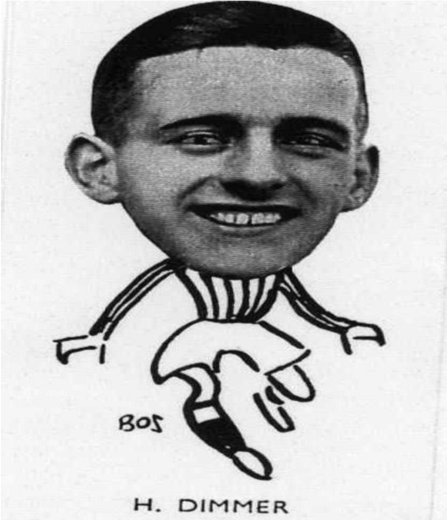
In 1936/37, the team scored 122 league goals and this remains a club record. Terry McGibbons is the club's second highest scorer of all time and he was simply rampant. With the season already underway, manager Frank Thompson made a swoop to sign Eddie Summers, Albert Smith and Jock Mayes from Clyde. In an earlier phase of his managerial career, Mr Thompson had acquired all three for Clyde. They made a quick impact. A draw at Airdrie preceded twelve consecutive league wins, this too comprising what remains a club record. Terry McGibbons struck form with a vengeance during that invincible run spanning 24th October, 1936, until 2nd January, 1937. Brechin City, Stenhousemuir and Montrose bore the brunt with each conceding eight goals at Ayr. These twelve games produced sixty-four goals for Ayr United. Five per match with four to spare! Only one home point was dropped in the entire season. The fabulous Hyam Dimmer excelled in the successful pursuit of the title. He was a flamboyant player who had the skill and willingness to entertain the crowd.
There was a definite impression that the First Division would hold no fears for a squad of players so rich in individual talent. The reality was different. When the final league Saturday was reached in 1937/38 it was known that Morton would be relegated. Since Queen of the South required to beat Rangers at Ibrox to escape it was reasonable to assume that Second Division football was destined for Dumfries. The assumption was wrong. They had a 3-0 lead at half-time causing a panic at the Ayr United versus Dundee game. People had turned up in the expectation of a relatively meaningless fixture but now it took on a different aspect. In the event of a Queen of the South win (they won 3-2) Ayr United needed at least a draw to avoid the drop and opponents Dundee required nothing less than a win. A relegation battle between the two clubs in peril! The tension was relieved when the whistle was blown on a 0-0 draw.
Football seldom has a sense of perspective but by the end of September 1938 the international situation became the major concern. War with Germany looked likely. Ayr Town Council now discussed such issues as first aid posts, gas masks and the distribution of food. Local papers gave information on how to build an air raid shelter. The threat receded with Neville Chamberlain's "peace in our time" declaration. 1938/39 then developed into a very chequered season. In January there was the embarrassment of getting knocked out of the Scottish Cup at Alloa. In March there was the elation of a 6-1 league win at home to Motherwell. Fourteenth place out of twenty at least staved off relegation fears.
On the resumption of pre-season training in July 1939 all twenty-two players reported to Somerset Park. Terry McGibbons, sold to Preston North End a year earlier, was an Ayr United player again. Jacky Cox, originally of Hamilton Accies, also departed Preston North End to sign for Ayr United. In 1956 he was to become the manager. High confidence in the summer of 1939 quickly proved to be a hoax. The initial league engagement was a 5-0 defeat away to Albion Rovers. In league fixture five, Jacky Clark scored a hat-trick when Hamilton Accies were beaten 6-1 at Ayr. His £4 a week contract was on the verge of becoming void. War was declared the next day and the league programme was abandoned. Being full-time, Ayr United's players were rendered unemployed, albeit that war work and military demands would ensure that they would be far from idle. Regional leagues got formed with Ayr United competing in the Southern and Western League. By now wages had been halved to £2 per week on a part-time basis. Finishing second from the foot was inglorious but the Scottish Second X1 Cup was won after beating Aberdeen in a two-legged final. It was an excellent achievement considering first teams played in that season's competition.
At the season's close, chairman Andrew Wright commented: "Football for next year is in the lap of the Gods". By the time this comment was reported there was another statement. "Ayr United is closed down until further notice." The decision to close down for the duration was contentious. Five decades later there were still Ayr United fans who would tell you that it was a wrong decision. The crux of the argument was that guest players were stationed in the area could have been used. An example given was Stanley Matthews who guested for Airdrie and Morton.
1940-1950
1940-1950
On 30th May, 1940, the Ayr United Annual General Meeting lasted for five minutes. It was reported that for the financial year ending 31st March, 1940, the loss was £2,674 : 11s :3d. Gate receipts for that period totalled £6,052 : 19s : 8d. This was less than half of the amount for the corresponding period the year before. It was quite simply down to the state of war and its consequent priority to the general public. With Ayr United now closed down for the duration Somerset Park fell into a state of neglect. Weeds grew out of control on the terracing. This was despite the two local junior clubs, Newton Rovers and S.S. and E. Athletic (Scottish Stamping and Engineering), using the ground on alternate Saturdays for their home fixtures in the Western League. The ground was also used for the occasional schools match in addition to some high profile representative matches. These were The RAF versus The Army in 1941 and Scottish Command versus Western Command in 1944, 1945 and even in 1946. All of these games took place on New Year's Day and included such illustrious players as Tommy Lawton and Billy Wright.
In March 1945 the directors began the process of signing players with a view to the club starting up again in 1945/46. Bob Ferrier quit his post as part time manager of Airdrie to become the full time manager of Ayr United. An earlier report that Matt Busby had been appointed was somewhat premature. The Scottish League structure for 1945/46 was a shameful carve-up driven by self interest. A new set-up was put in place comprising Divisions 'A' and 'B'. The completed First Division table for the last peacetime season was ignored. Ayr United got placed in 'B' Division despite having finished above three of the new 'A' Division clubs in 1938/39. There was also a phantom promotion for Morton. The set-up created a grudge which Ayr supporters of the time would harbour into old age.
Due to age there were players on the retained list who would never play for Ayr United again. Others such as Hugh McConnell, Albert Stewart and Lewis Thow had yet to be demobbed from the forces. The recruitment was rapid. Peter Smith became the club's first post war captain when he was recalled from Pollok Juniors. When the league season got underway Airdrie won 3-0 at Somerset Park in the opening match. There was a significant development before the next fixture. Centre-half Norrie McNeil was signed from Hurlford United, his local club. Norrie had already played alongside and against some of the greatest names in British football whilst competing in representative football in the army. He would proceed to become an Ayr United great
With only fourteen clubs in the league the programme extended to a mere twenty-six figures which concluded in January with Ayr United finishing in a creditable third place. For Malky Morrison it was a season of goalscoring abandon with twenty-nine league goals. On 5th January, 1946, he netted six in a 10-1 victory at home to Stenhousemuir. This remains a club record league win. Malky had already scored four in our 6-0 rout of Stenhousemuir in October 1945. A personal haul of ten goals in the two league games against that club!
The new League Cup tournament got underway in February. Ayr United's first engagement in that competition saw a 1-0 win at Dumbarton. Our historic first League Cup goal was scored by Bert Harper. On progressing from the group stages Aberdeen were faced in the quarter-finals in front of a crowd of 18,128 at neutral Dens Park, Dundee. Aberdeen won 2-0 then went on to lift the trophy.
Upon his release from Rangers the great Alec Beattie was signed in the summer of 1946. He was an outside-left who was adept at scoring from tight angles and, in the present day, he holds the Ayr United record for scoring directly from corner-kicks. The post war gates boom was still thriving but the large crowds and wealth of individual talent did not count for much. Finishing eleventh in the fourteen-club 'B' Division was a major disappointment even allowing for the final fixture bringing a 6-1 home win over Cowdenbeath. The Scottish Cup also proved disastrous with an 8-0 defeat at Aberdeen who went on to lift the cup (echoes of the League Cup a year before). Compounding the severity of the Pittodrie defeat was the fact that goalkeeper Willie Barbour was described as "the hero of the side". The league placing in 1946/47 was replicated in 1947/48 but this time it was eleventh out of sixteen since the league had two more clubs.
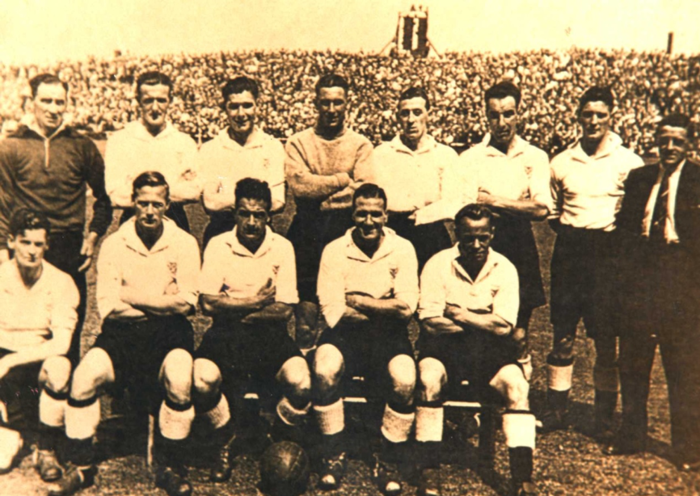
Getting back into the top tier continued to be a forlorn hope. This was probably the mindset of Bob Ferrier who quit in December 1948. The process of appointing a new manager was tortuous. Eventually, in mid-March, Archie Anderson was named as the new boss. This was three days after beating Dundee United 8-0 in a 'B' Division fixture. Anderson had managed Arbroath when they reached the semi-finals of the Scottish Cup in 1947. Here in 1949 it proved difficult to extricate himself from the Arbroath job. By the time he was free to start work at Ayr the league season was over with ninth place being occupied. He took charge for the post season Highland tour. Mr Anderson would bring about improvement although none would be forthcoming in his first full season in charge. Fourth bottom of the lower tier and eliminated from the Scottish Cup with a 4-0 defeat away to Dundee United!
A new decade at least brought the hope of a fresh dawn.
1950-1960
1960-1970
1970-1980
1980-1990
1990-2000
2000-2010
2000 Onwards
